Chanson: Marie Möör - Pretty Day (1982) Film: Ballet Mécanique (1924) de Fernand Léger
Saturday, 3 October 2020

Thursday, 24 September 2020
"J'entends, J'entends" by Anna Karina
Anna Karina sings Jean Ferrat's poem "J'entends J'entends" in Jean-Luc Godard's "Bande à Part"
Tuesday, 19 January 2016
Monday, 18 January 2016

Tuesday, 18 August 2015
Monday, 20 July 2015
Kino-Eye
by Dziga Vertov
I’m an eye. A mechanical eye. I, the machine, show you a world the way only I can see it. I free myself for today and forever from human immobility. I’m in constant movement. I approach and pull away from objects. I creep under them. I move alongside a running horse’s mouth. I fall and rise with the falling and rising bodies. This is I, the machine, manoeuvring in the chaotic movements, recording one movement after another in the most complex combinations. Freed from the boundaries of time and space, I co-ordinate any and all points of the universe, wherever I want them to be. My way leads towards the creation of a fresh perception of the world. Thus I explain in a new way the world unknown to you.
Tuesday, 26 May 2015
Tuesday, 5 May 2015
Saturday, 7 February 2015
Vivien: Homage to Mucha
by Doris Fiebig

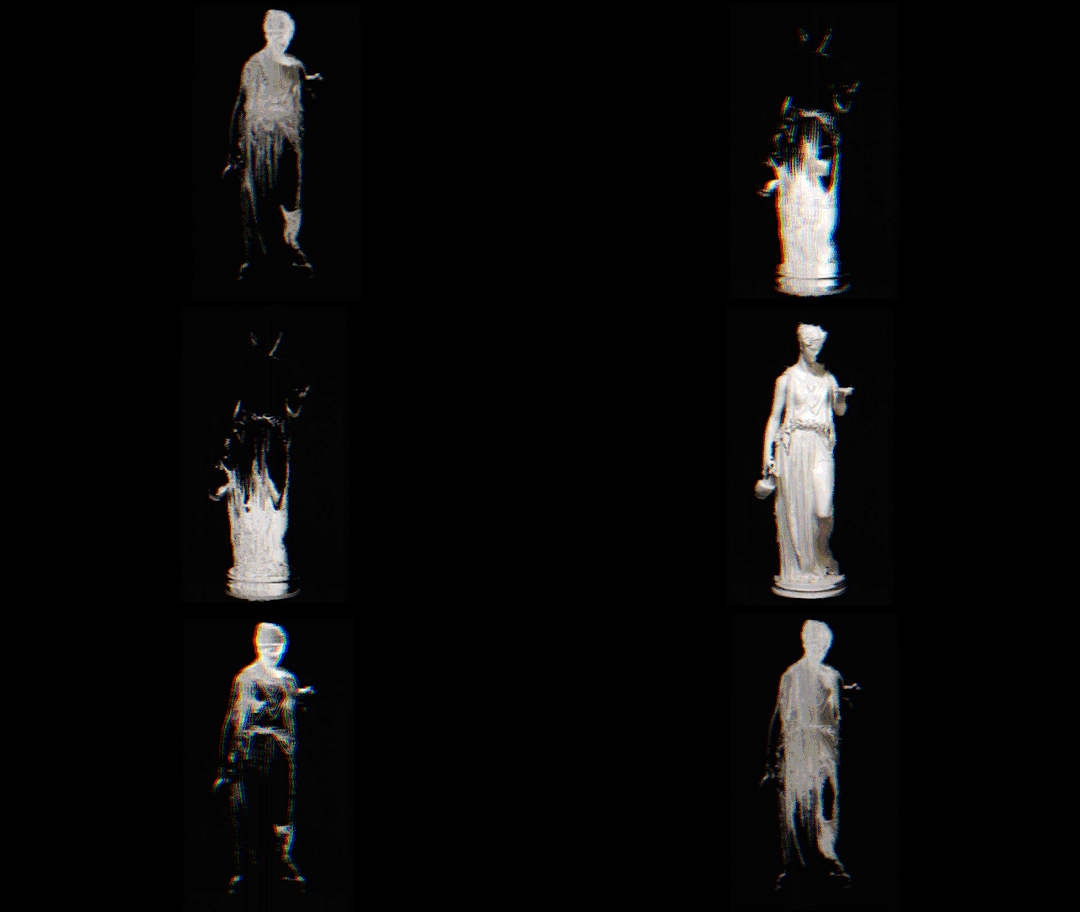
Since I am a great fan of Alphonse Mucha, this mesmerising artwork has captured my eye and seized my soul in an instant. At first I thought it was a real sculpture, but Doris Fiebig has created this classic yet modern artwork by using zbrush and blender. See how this beauty came to life by checking the metamorphosis of her works on:
Wednesday, 4 February 2015
Sun Ra
"There is some disagreement as to Sun Ra's date of birth. he stated that he had "arrived on earth" on a number of dates. He was fond of showing his doubters his United States passport, which clearly gave the place of birth as the planet Saturn. 22nd May 1914 appeared on his passport, but other sources place his birth anywhere from 1910 to 1918; most sources support a birth year of 1914 or 1915."
http://en.wikipedia.org/wiki/Sun_Ra
http://en.wikipedia.org/wiki/Sun_Ra
Monday, 2 February 2015
Sunday, 1 February 2015

Thursday, 29 January 2015
Doppelganger
The other day I ran into myself on the street.
I knew it was me. Same face, same pants, same shirt.
I wonder what I was thinking.
I got in my car and someone already was behind the wheel. It was me.
When we got home, I opened the door and there I was.
By Unknown
I knew it was me. Same face, same pants, same shirt.
I wonder what I was thinking.
I got in my car and someone already was behind the wheel. It was me.
When we got home, I opened the door and there I was.
By Unknown
Thursday, 8 January 2015
Sunday, 4 January 2015
Karin's Cabin
There's a lodge on the hill
and it's buried in snow
it's a home to awake
it's a home for lost souls
where a family's born
at an opulent meal
halved oranges glow
the pomegranates reveal
a cluster of crimsons
a still life come true
nothing that we are lacking
nothing that we could lose
And exstatic laughter is filling the air
a baroque celebration
under gold chandeliers
Stars enlighten the passage in the night
where the moon is radiating
everything will ignite
like the fireworks guiding us in a new year
the corona in colours so bright in the sphere -
delirious dancing beyond the dimensions
a festive sensation of our existence.
Saturday, 20 December 2014
Samsara
From the Tibetan Book of Living and Dying
Sometimes I think that the greatest achievement of modern culture is its brilliant selling of samsara and its barren distractions. Modern society seems to me a celebration of all the things that lead away from the truth, make truth hard to live for, and discourage people from even believing that it exists. And to think that all this springs from a civilization that claims to adore life, but actually starves it of any real meaning; that endlessly speaks of making people "happy", but in fact blocks their way to the source of real joy.
This modern samsara feeds of an anxiety and depression that it fosters and trains us all in, and carefully nurtures with a consumer machine that needs to keep us greedy to keep going samsara is highly organised, versatile, and sophisticate; it assaults us from every angle with its propaganda, and creates an almost impregnable environment of addiction around us. The more we try to escape, the more we seem to fall into the traps it is so ingenious at setting for us. As the eighteenth century Tibetan master Jikme Lingpa said: Mesmerized by the sheer variety of perceptions, beings wander endlessly astray in samsara's vicious cycle.
Obsessed, then, with false hopes, dreams and ambitions, which promise happiness but lead only to misery, we are like people crawling through an endless desert, dying of thirst. And all that this samsara holds out to us to drink is a cup of salt water, designed to make us even thirstier.
Tuesday, 16 December 2014
Sunday, 30 November 2014
Poem of the Atoms
O day, arise!
The atoms are dancing,
overcome with ecstasy.
overcome with ecstasy.
I'll whisper in your ear where their dance is leading them.
All the atoms in the air and in the desert know well,
they seem insane.
they seem insane.
Every single atom, happy...or miserable,
becomes enamoured of the sun,
becomes enamoured of the sun,
of which nothing can be said.
Jalal ad-Din Rumi
Sunday, 9 November 2014
The Superman vs. Weltschmerz
Nietzsche vs. Schopenhauer
Schopenhauer's concept of cosmic pain (Weltschmerz) and his philosophy of compassion (Mitleid), explore the human experience of empathy, and thus to our interconnectedness as human beings.
Despite of Nietzsche's admiration for Schopenhauer, Nietzsche was strictly against his philosophy of pity. Even though it is known that Nietzsche aimed at transvaluing all values, one still wonders how one could possibly resent such a beautiful idea.
Nietzsche however, believed that feelings of compassion only weakened the possibility to become a Superman (Übermensch). For him, the Superman is not someone with super-magical powers, but one who has transcendent the ego completely. In order to reach this state of mind, the individual has to surpass three stages. First, there is "the camel" with it's burden on it's back. Carrying the weight of the world, he eventually reaches the stage of the lion in which no more suffering exists, but total control, will power and strength. The final stage however, has surpassed all these conscious and ego ridden stages and results in the blissful state of "the child". This stage can be compared to the Golden Age, in which we see the wonders of the world with the innocence of childlike eyes.
As Nietzsche believed to carry the pain of the world on his shoulders, he chose to live in solitude in the Swiss Alps for several years. Here, according to his three stages, he found himself to be in the stage of the camel, indulging on his calamity. When he eventually believed to have surpassed this stage, he was ready to become the lion, and thus to re-socialise in order to teach his philosophy, just as the prophets had done before him after their enlightenment in solitude. In the form of Zarathustra, he finally walks down from his ivory tower in the mountains, but only to find that the first villagers he speaks to have no ears to listen! Nietzsche never reached the last stage on the way to transcend and become the Superman. Instead, he escaped from the conscious state of mind that he intended to surpass with his forthcoming insanity.
Thursday, 30 October 2014
Subscribe to:
Posts (Atom)
"Pretty Day" by Marie Möör
Chanson: Marie Möör - Pretty Day (1982) Film: Ballet Mécanique (1924) de Fernand Léger

-
Nietzsche vs. Schopenhauer Schopenhauer's concept of cosmic pain (Weltschmerz) and his philosophy of compassion (Mitleid), explore...


